

Hydraulic Cylinder Market Forecast to Reach US$22.7 Bn by 2032 | Persistence Market Research Analysis
News originally published by
EIN Presswire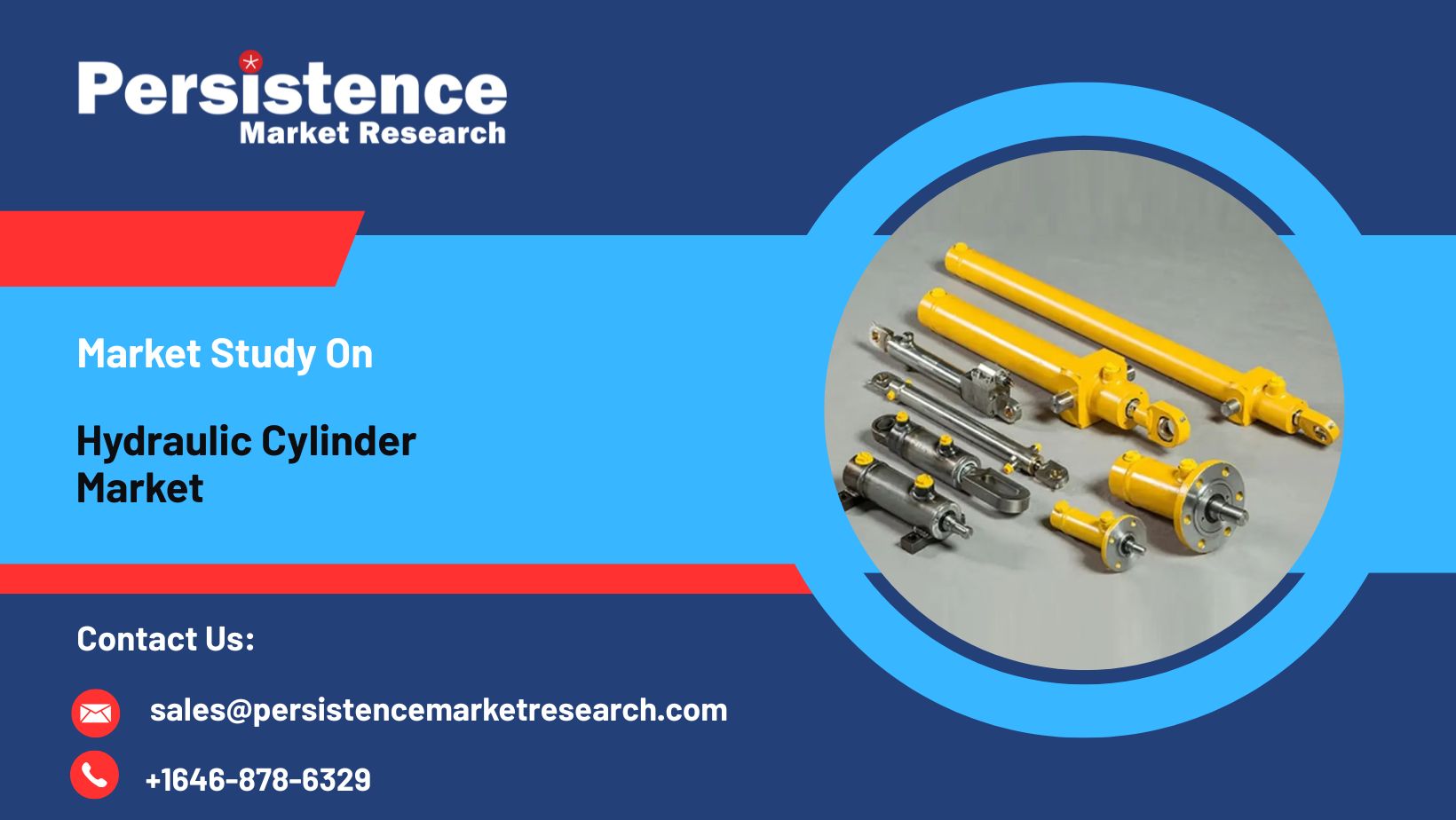
Hydraulic Cylinder Mkt
High manufacturing costs make hydraulic cylinder production challenging for smaller companies.
LONDON, MAHARASHTRA, UNITED KINGDOM, January 16, 2026 /EINPresswire.com/ -- The hydraulic cylinder market forms a critical backbone of modern industrial, construction, agricultural, and material-handling equipment. Hydraulic cylinders convert pressurized fluid energy into linear mechanical force, enabling lifting, pushing, pulling, and positioning of heavy loads with precision and reliability. From excavators and cranes to manufacturing presses and agricultural harvesters, hydraulic cylinders are integral to operations that demand high force density and controlled motion.
In 2025, the global hydraulic cylinder market was valued at US$15.6 billion, reflecting strong demand across construction, agriculture, mining, manufacturing, and logistics. The market is projected to reach US$22.7 billion by 2032, growing at a CAGR of 5.5% during the forecast period. This growth is primarily driven by expanding infrastructure investments, the rapid adoption of industrial automation, and the rising penetration of advanced construction and agricultural machinery in developing economies.
𝐃𝐨𝐰𝐧𝐥𝐨𝐚𝐝 𝐅𝐫𝐞𝐞 𝐒𝐚𝐦𝐩𝐥𝐞 & 𝐂𝐡𝐞𝐜𝐤 𝐭𝐡𝐞 𝐋𝐚𝐭𝐞𝐬𝐭 𝐌𝐚𝐫𝐤𝐞𝐭 𝐀𝐧𝐚𝐥𝐲𝐬𝐢𝐬: https://www.persistencemarketresearch.com/samples/4713
Key Highlights from the Report
• The global hydraulic cylinder market is projected to grow at a CAGR of 5.5% from 2025 to 2032.
• Rising infrastructure development is driving strong demand for hydraulic systems in construction machinery.
• Double-acting hydraulic cylinders remain the dominant product segment due to operational flexibility and high efficiency.
• Asia-Pacific leads the market, supported by industrial expansion and large-scale urban development projects.
• Increasing automation across manufacturing and logistics is creating sustained demand for precision hydraulic components.
• Technological advancements in sealing, materials, and digital monitoring are enhancing product life and performance.
Market Segmentation
The hydraulic cylinder market is segmented primarily by product type, function, and end-use industry, each reflecting distinct operational requirements and performance expectations. Based on product type, the market includes single-acting, double-acting, telescopic, welded, and tie-rod cylinders. Single-acting cylinders, which use hydraulic pressure in one direction, are commonly applied in lifting and clamping operations where gravity or external force returns the piston. However, double-acting cylinders dominate overall demand as they provide controlled motion in both extension and retraction, making them suitable for complex machinery in construction, manufacturing, and material handling.
By end-use industry, the market spans construction, agriculture, mining, manufacturing, aerospace, marine, oil and gas, and material handling. The construction sector remains the largest consumer, driven by heavy usage of hydraulic systems in earthmoving equipment, road-building machinery, and infrastructure development tools. Agriculture represents another major segment, with hydraulic cylinders integral to tractors, harvesters, plows, and irrigation systems. Manufacturing and industrial automation are rapidly expanding end-user segments as factories adopt hydraulic-powered presses, robotic systems, and automated material-handling equipment. Mining, marine, and oil and gas applications further contribute to demand, particularly for heavy-duty cylinders capable of operating under extreme pressure, temperature, and environmental conditions.
𝐆𝐞𝐭 𝐚 𝐂𝐮𝐬𝐭𝐨𝐦𝐢𝐳𝐞𝐝 𝐌𝐚𝐫𝐤𝐞𝐭 𝐕𝐢𝐞𝐰 𝐢𝐧 𝐎𝐧𝐞 𝐂𝐥𝐢𝐜𝐤 : https://www.persistencemarketresearch.com/request-customization/4713
Regional Insights and Market Dynamics
Asia-Pacific holds the leading share of the global hydraulic cylinder market, supported by rapid industrialization, massive infrastructure investments, and a growing construction equipment manufacturing base. China remains the largest contributor, driven by extensive urban development, transportation projects, and continued expansion of industrial facilities. India is emerging as a high-growth market due to government-led infrastructure initiatives, increased mechanization in agriculture, and the expansion of domestic manufacturing under industrial development programs. Southeast Asian countries such as Indonesia, Vietnam, and Thailand are also witnessing rising demand for construction machinery and agricultural equipment, further strengthening regional growth.
North America represents a mature yet steadily expanding market, characterized by strong demand from construction, mining, and manufacturing sectors. The United States continues to invest in infrastructure rehabilitation, renewable energy projects, and industrial automation, all of which require high-performance hydraulic systems. Replacement demand is also significant, as aging machinery in industrial plants is upgraded to improve efficiency, safety, and compliance with environmental standards.
Europe remains a key market driven by industrial automation, renewable energy installations, and advanced manufacturing. Countries such as Germany, France, and the United Kingdom emphasize high-precision machinery, energy efficiency, and environmental sustainability, prompting demand for technologically advanced hydraulic cylinders.
𝐂𝐥𝐢𝐜𝐤 𝐭𝐨 𝐏𝐮𝐫𝐜𝐡𝐚𝐬𝐞 𝐭𝐡𝐞 𝐅𝐮𝐥𝐥 𝐑𝐞𝐩𝐨𝐫𝐭 & 𝐒𝐭𝐚𝐫𝐭 𝐄𝐱𝐩𝐥𝐨𝐫𝐢𝐧𝐠 : https://www.persistencemarketresearch.com/checkout/4713
Market Restraints
Despite its positive growth outlook, the hydraulic cylinder market faces several restraints that could limit expansion in certain regions and applications. One of the primary challenges is the relatively high cost of advanced hydraulic systems compared to alternative motion-control technologies. Precision-engineered cylinders, particularly those designed for high-pressure or specialized applications, require high-quality materials, advanced manufacturing processes, and rigorous testing, which can increase production costs. For small and medium-sized enterprises, these costs may act as a barrier to adoption, particularly in price-sensitive markets.
Market Opportunities
The hydraulic cylinder market presents significant opportunities driven by technological innovation and evolving industry requirements. One of the most promising areas is the integration of digital monitoring and smart sensor technologies into hydraulic systems. Smart hydraulic cylinders equipped with sensors for pressure, temperature, and position enable real-time performance monitoring, predictive maintenance, and improved operational efficiency. As industries increasingly adopt Industry 4.0 practices, demand for intelligent hydraulic components is expected to grow substantially.
Company Insights:
• Parker Hannifin Corporation
• Bosch Rexroth AG
• Eaton Corporation
• Caterpillar Inc.
• HYDAC International
• SMC Corporation
• KYB Corporation
• Wipro Infrastructure Engineering
• Danfoss A/S
• Texas Hydraulics Inc.
Recent developments in the market reflect a strong emphasis on technological advancement and strategic expansion. In 2024, several leading manufacturers introduced smart hydraulic cylinders integrated with IoT-based monitoring systems.
𝐑𝐞𝐥𝐚𝐭𝐞𝐝 𝐑𝐞𝐩𝐨𝐫𝐭𝐬:
Vacuum Lifter Market: The vacuum lifter market is projected to reach US$2.5 billion by 2032, driven by safer material-handling demand.
Liquid Filling Machines Market: The liquid filling machines market is set to grow from US$7.0 billion in 2026 to US$10.9 billion by 2033 at a 6.5% CAGR.
Ganesh Dukare
Persistence Market Research
+1 646-878-6329
email us here
Visit us on social media:
LinkedIn
Instagram
Facebook
X
Legal Disclaimer:
EIN Presswire provides this news content "as is" without warranty of any kind. We do not accept any responsibility or liability for the accuracy, content, images, videos, licenses, completeness, legality, or reliability of the information contained in this article. If you have any complaints or copyright issues related to this article, kindly contact the author above.
